The situation is dramatic: Europe is in danger of becoming a pawn in the game of other powers.
This underscores the necessity for Europe to secure its sovereignty and ability to act independently. Important
steps have been taken in the area of defense, yet security and strategic independence fundamentally require an
economically strong Europe. Competitiveness and economic strength are therefore essential for a sovereign,
strong, and self-determined Europe.
Like no other, Mario Draghi stands for the economic strengthening of Europe, and the 2024 Draghi Report,
represents the necessary strategy to ensure competitiveness, growth, and stability on the continent. In
recognition of his current impulses and his outstanding life's work in the service of this central cause, as well as
in acknowledgment of his historic contributions to the preservation, consolidation, and further development of
the European Economic and Monetary Union as an indispensable cornerstone of integration, the Board of
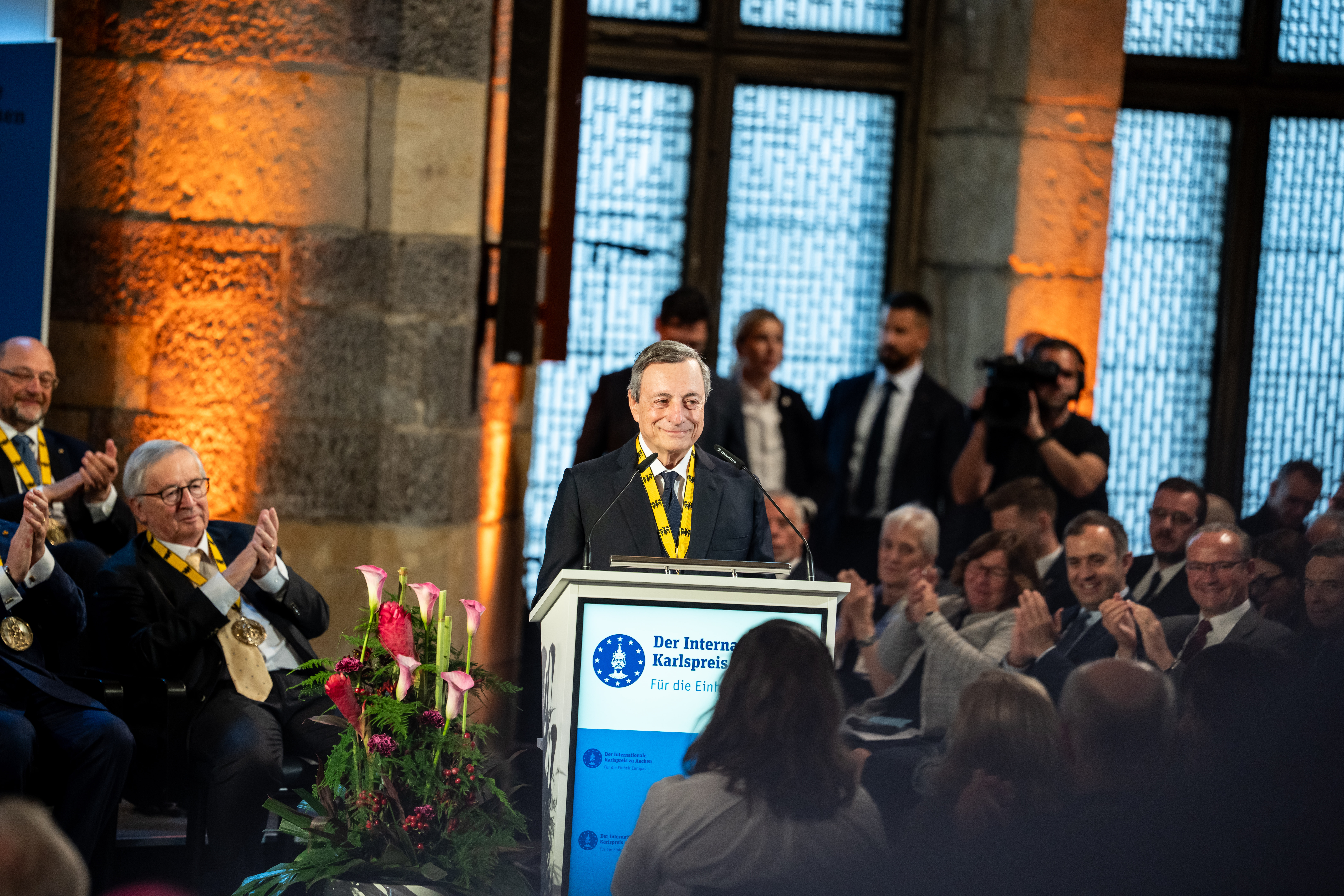
Directors of the Society for the Conferring of the International Charlemagne Prize of Aachen in the year 2026
honours the former President of the European Central Bank and former Prime Minister of the Italian Republic,
Professor Mario Draghi.
In times of great uncertainty and challenge, we need bridge builders, mediators and warning voices, visionaries
and strategic thought leaders with the ability to recognise and create paths towards a better future. Leaders who
take responsibility at historic milestones, when century-long projects are in danger of failing, even at times of
uncertain public approval and failing support from large sections of the political establishment. Decision-makers
and doers such as Mario Draghi.
Just under a decade and a half ago, the European Union stood at such a crossroads, and Mario Draghi took on
this responsibility! He made a decisive call: “Whatever it takes!” Today, he remains one of the most prominent
figures guiding the EU toward greater competitiveness, unity, and strength.
“Over the years, the Union has repeatedly responded to crises, often exceeding all expectations. During the
COVID crisis, we overcame the historical taboo of shared debt and helped each other. We implemented a massive
vaccination campaign in record time. We responded to Russia's invasion of Ukraine with unprecedented unity
and determination. However, these were responses to emergency situations. Today, the challenge is different:
acting with the same determination in normal times to address new realities. This new world is not kind to us. It
does not wait for slow, collective rituals before demonstrating its strength. It demands radical changes to our
goals, timetables, and working methods.
[…] In short, Europeans must find their way back to unified action. The point is not to act only when circumstances
become untenable, but now — while we still have the power to shape our future." (Mario Draghi, August 22,
2025, Rimini)
Mario Draghi was born in Rome on September 3, 1947. He attended the Jesuit-run Istituto Massimiliano
Massimo, a Catholic private school in Rome, before studying economics at La Sapienza University, from which he
graduated with top marks in 1970. In 1977, he became the first Italian citizen to earn a doctorate from the
Massachusetts Institute of Technology. His dissertation, “Essays on Economic Theory and Applications”, was
supervised by no other than Nobel Prize–winning economists Franco Modigliani and Robert Solow.
From 1975 to 1981, he was a professor of economics at the Universities of Trento, Padua, and Venice. In 1981,
he accepted a professorship in economics and monetary policy at the University of Florence, which he held
intermittently until 1991. In 1984, he was appointed to the World Bank in Washington, D.C., as an executive
director for six years. He joined the Italian Ministry of the Treasury as Director General in 1991, serving for over
ten years under roughly the same number of elected governments.
The senior official and closest associate of the then Minister of the Treasury and later President, Carlo Ciampi,
honoree of the Charlemagne Prize in 2005, was already involved at the European level in the development of the
European Economic and Monetary Union, specifically the Maastricht criteria. Draghi succeeded in restructuring
the Italian national budget. Through the sale of banks, energy, and telecommunications companies alone, the
privatization committee headed by Draghi raised around €60 billion. As a result of the rigid fiscal policy, the
country's budget deficit, debt ratio, and inflation rate were significantly reduced, enabling Italy — contrary to
the expectations of many experts — to meet the criteria for the introduction of the single currency and join the
circle of eleven founding members.
Professor Mario Draghi was initially appointed as a lecturer at Harvard University in 2001 and then took up the
position as Vice Chairman and Managing Director at the London office of the U.S. investment bank Goldman
Sachs in 2002. At the end of December 2005, he was appointed Governor of the Banca d'Italia for six years,
thereby becoming a member of the ECB Governing Council. In this role, Draghi consistently urged the Italian
governments of Prodi and Berlusconi to return to a course of stability and growth and adopt stricter austerity
policies.
Draghi was discussed as a possible successor to Jean-Claude Trichet as early as 2009. In June 2011, the European
Council appointed him President of the European Central Bank. He began his eight-year term on November 1,
2011.
While his predecessor had hoped that the government bond purchases decided upon in May 2010 would prompt
politicians to fulfill their responsibilities promptly, the following months revealed that the ECB had to act as a
repair shop for political failures to convince the markets, and above all the more than 300 million citizens of the
eurozone, of the trustworthiness of their currency in the wake of the debt crisis.
As the situation on the increasingly unsettled financial markets worsened amid the euro crisis, with considerable
doubt that weaker eurozone members would ever repay their debts, and as the eurozone threatened to become
a battleground for investors, Draghi seized the opportunity of the Global Investment Conference in London on
July 26, 2012, to make a now-famous announcement: “Within our mandate, the ECB is ready to do whatever it
takes to preserve the euro. And believe me, it will be enough.”
On September 6, 2012, the ECB made the risky decision to purchase unlimited amounts of government bonds
from European crisis countries under certain conditions to secure the continued existence of the euro. This
decision, known as the OMT program, was sharply criticized in many quarters, particularly in Germany. However,
the mere announcement of this decision calmed the markets at a time when the eurozone's collapse was a real
possibility. Supporters viewed Draghi's move as the only feasible option since governments appeared unable to
swiftly implement reforms. Ultimately, Germany also recognized the importance of this fundamental decision.
At the award ceremony for the Grand Cross of the Order of Merit of the Federal Republic of Germany in January
2020, German President Frank-Walter Steinmeier addressed Draghi with the utmost respect: "At a time when
there were no developed European instruments for crisis intervention, you had to act with the instruments of a
central bank. You had to act in a scenario for which there was no European script. A scenario in which waiting
was not an option. And you acted. You preserved what others seemed ready to give up. No one likes to imagine
where Europe would be today if the United Kingdom had not only left the European Union but the eurozone had
also broken apart at the same time. You fought against this with all your might.”
Mario Draghi resigned from his position as President of the ECB at the end of his term in 2019. A little over a year
later, when the Conte government collapsed in his home country, President Sergio Mattarella tasked him with
forming a “government of national unity” as a “last hope,” so to speak, in order to avoid new elections in light of
the ongoing COVID crisis. He took office as prime minister on February 13, 2021.
Indeed, he achieved what had long seemed unthinkable. Within a few months, Italy had more vaccinated people,
fewer cases of the coronavirus, and fewer critically ill patients than most other European countries. With an
economic growth rate of nearly 9%, Italy's economy grew significantly stronger than the EU average. Unlike his
predecessor, Draghi developed convincing concepts and project plans for investments that primarily benefited
infrastructure, digitalization, and ecological transformation with funds from the EU Recovery Fund in a very short
time.
Draghi's cabinet, which deliberately did not include any leaders of major political parties, worked quietly,
consistently, and efficiently, thereby leading the country out of crisis, stabilizing it, and bringing about a change
in public sentiment. Thanks in part to long-delayed administrative and judicial reforms, the population regained
confidence in its own institutions. In 2021, the respected business magazine The Economist named Italy "Country
of the Year" - largely due to Draghi's efforts.
He found an important ally in French President Emmanuel Macron regarding foreign and European policy, with
whom he drew up a friendship treaty in November 2021 that is reminiscent of the Franco-German Élysée Treaty,
not only in terms of its name (after the official residence of the Italian president: “Quirinal Treaty”).
When Russia launched a brutal war of aggression against Ukraine on February 24, 2022, Draghi was the first
Western statesman to clearly advocate for Ukraine's EU accession prospects, and supported the EU's
unprecedented sanctions policy against Russia and arms deliveries to Kyiv from the start.
In July 2022, the fragile government coalition collapsed, prompting President Mattarella to accept the resignation
of his popular prime minister, who was highly respected internationally. The country was needlessly "retiring its
best," and even media outlets that had been less supportive of Draghi expressed incomprehension at Rome's
politics. However, this enabled European Commission President Ursula von der Leyen to commission Draghi the
following year to draw up proposals for improving the Union's competitiveness.
At the beginning of the new legislative period, a formative phase in the (re)orientation of the European
Parliament and the Commission, the “Report on the Future of European Competitiveness” was published on
September 9, 2024. In it, Draghi identifies several key policy areas and critical aspects for generating sustainable
growth:
- Closing the innovation gap with the US and China
- European plan for decarbonization and competitiveness, including lowering energy prices
- Increasing security and reducing dependencies
- Increasing investment, and
- A more coordinated approach at the EU level
Overall, the report provides a thorough analysis of the challenges and opportunities that the EU is facing, and it
develops strategic approaches to promote growth and stability, as well as proposing specific measures.
Draghi is convinced that the EU requires "radical change" to "survive today and tomorrow" in an ever-changing
world. While much of his report is not new or revolutionary, it has shaken up the EU institutions.
“To face today’s challenges, the European Union must transform itself from a spectator—or at best a supporting
actor—into a protagonist. Its political organisation must also change, inseparable as it is from its ability to achieve
its economic and strategic objectives. Economic reforms remain a necessary condition on this path of awareness.
[…] Governments must define which sectors to prioritise for industrial policy. They must remove unnecessary
barriers and review permitting structures in the energy sector. They must agree on how to finance the massive
investments needed in the future […]. And they must design a trade policy suited to a world that is abandoning
multilateral rules.”
Not without reason, the term "wake-up call" quickly circulated among journalists and top politicians - a wake-up
call that will help shape the political agenda for a long time to come and is of existential importance for the future
of the Union and its acceptance by its citizens. For Mario Draghi reminds Europe of its origin: economic strength
is not an end in itself, but the prerequisite for peace, stability, and the ability to ensure its own defense.
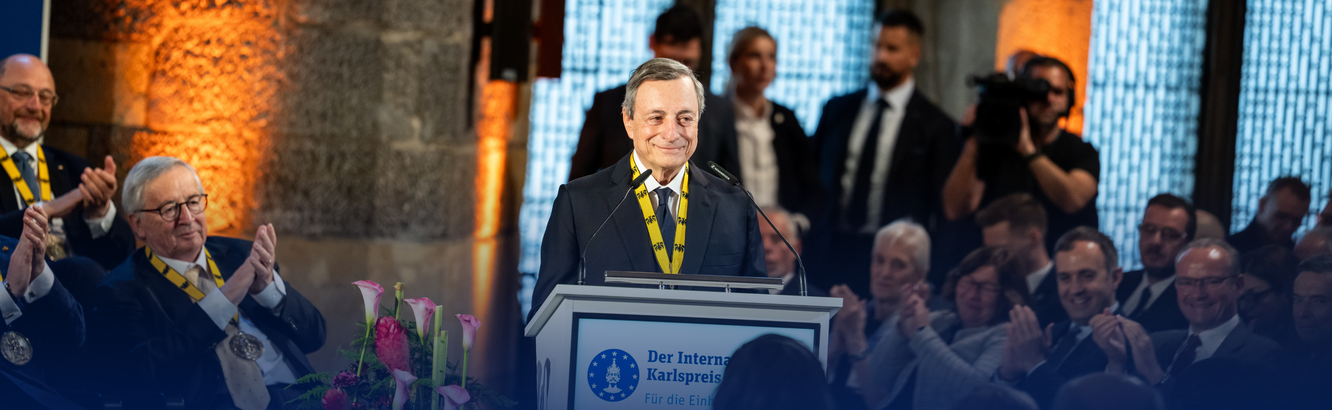
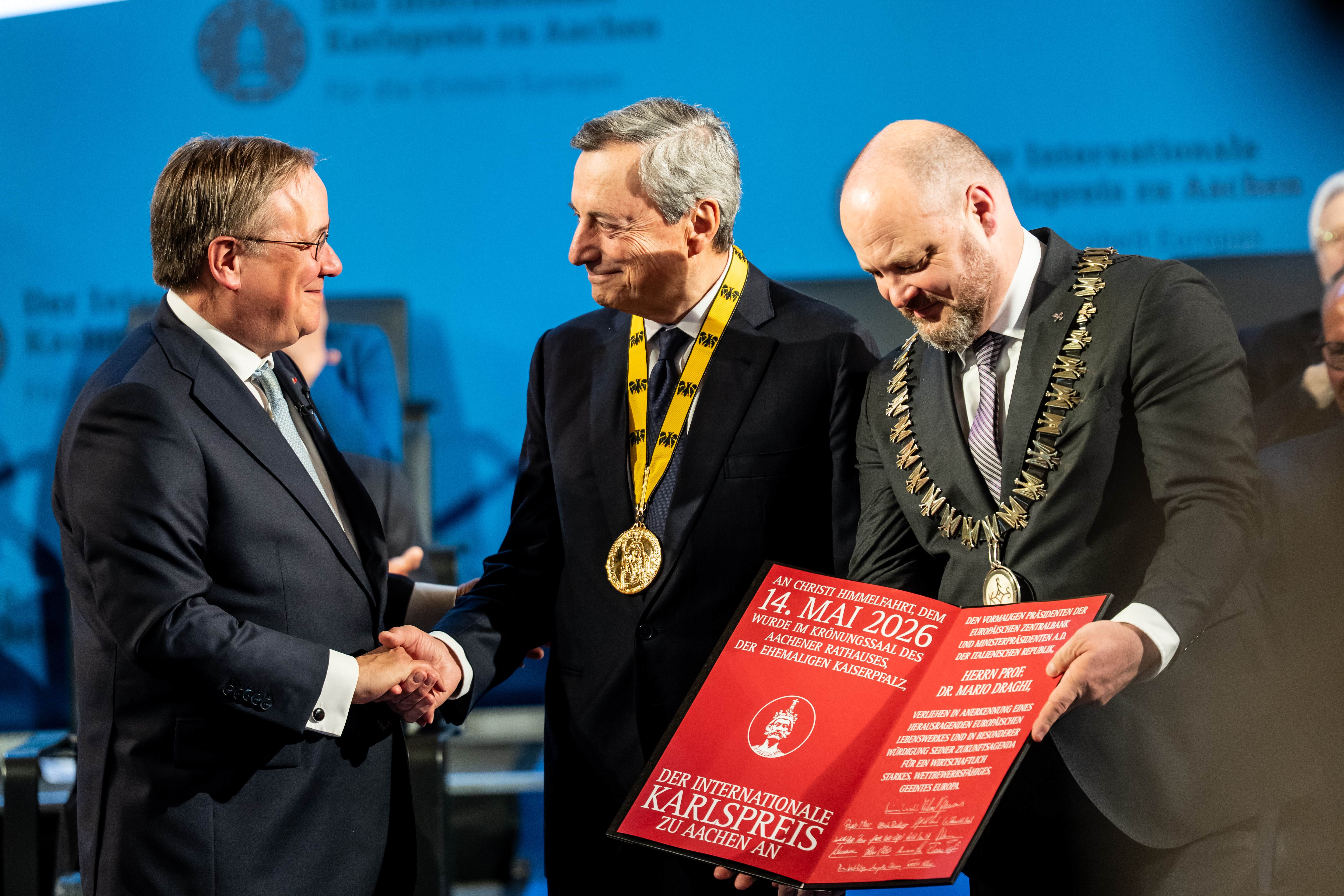
With Prof. Mario Draghi, the Charlemagne Prize Directorate honors a personality who has achieved great things
for Europe with focus and unwavering determination: the rescue of the euro, the stabilization of his home
country in its gravest crisis, and now the formulation of a future agenda for the entire continent. The award for
his outstanding life's work is therefore far more than a tribute to the past. It is an affirmation of the existential
importance of his latest wake-up call and, at the same time, a call to all political and social forces in Europe to
take his analysis seriously and to decide and act courageously themselves now. The awarding of the 2026
Charlemagne Prize to Mario Draghi is thus a deliberately set signal for the urgently needed setting of priorities:
Europe must renew its economic strength to be able to shape its future in a self-determined way. We call on the
European Commission and the European heads of state and government to implement the Draghi Report now.




.jpg)